
Introduction
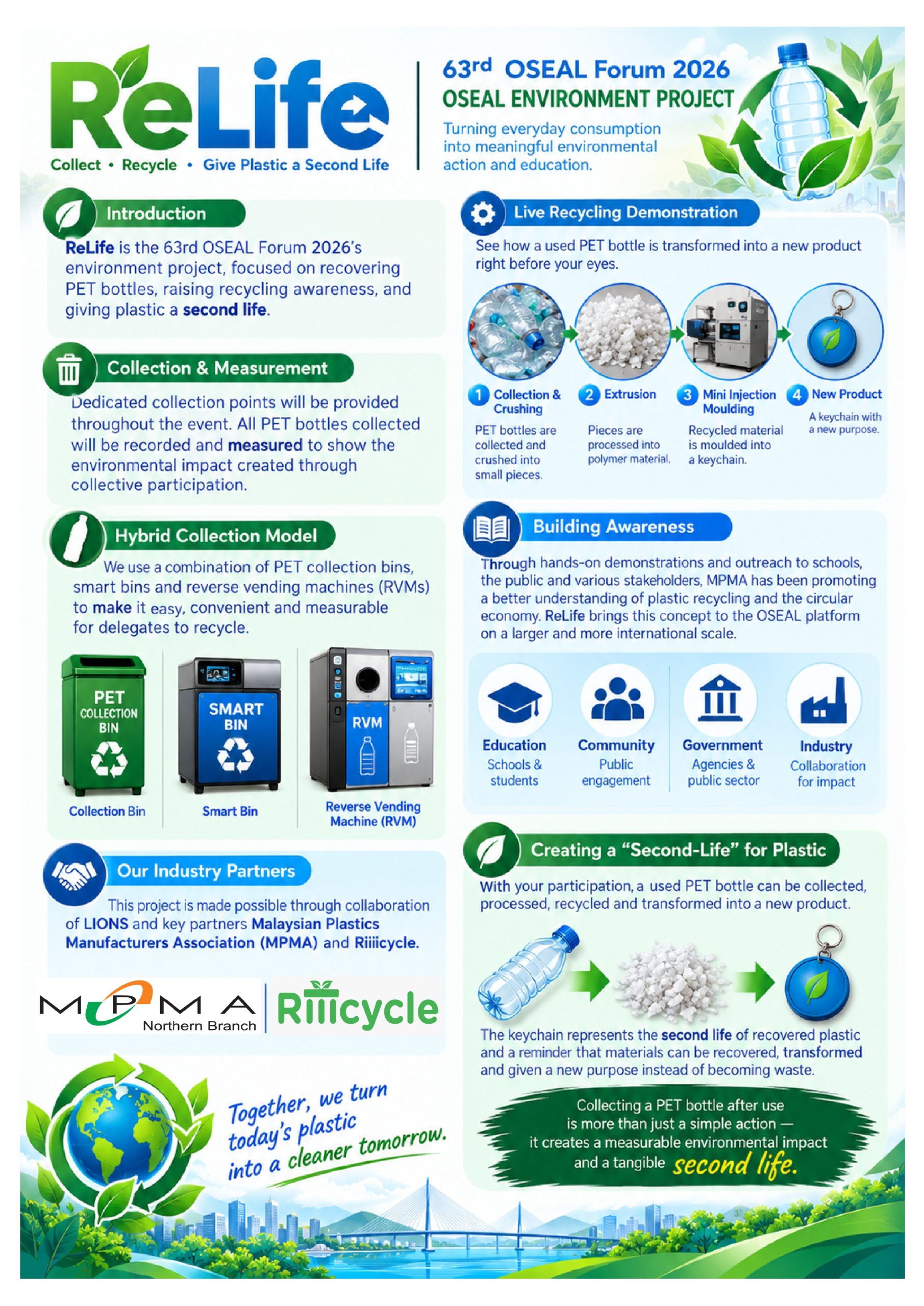
ReLife is an 63rd OSEAL Forum 2026’s Special Project focused on promoting responsible plastic waste management, recycling awareness, and the concept of giving plastic a second life. The project aims to recover and measure the PET (polyethylene terephthalate) bottles used throughout the event, turning everyday consumption into an opportunity for meaningful environmental action and education.
Through ReLife, dedicated collection points will be provided to recover PET bottles used by delegates during the event. The total quantity of PET bottles recovered will be recorded and measured, allowing the project to quantify the amount of plastic collected and demonstrate the environmental impact created through collective participation.
For PET bottle collection, ReLife will adopt a hybrid collection model combining dedicated PET collection bins with additional smart bins and reverse vending machines (RVMs). This approach provides multiple convenient collection channels for delegates while integrating conventional collection methods with smart technology to improve participation, traceability, and the measurement of PET bottles recovered throughout the event.
The project is made possible through collaboration with key partners in Malaysia’s plastics and recycling industry, including the Malaysian Plastics Manufacturers Association (MPMA), and Riiicycle. Together, our partners will support the project by providing two specialised machines and facilities to facilitate the collection and recovery of PET bottles throughout the event.
A key highlight of ReLife will be the live recycling demonstration conducted by MPMA, where participants and OSEAL delegates will be able to witness how a used PET bottle can be transformed into a new product. The process will begin with the collection and crushing of PET bottles, breaking them down into small plastic pieces. These pieces will then go through an extrusion process, where the plastic is processed into polymer material. The recycled material will subsequently be fed into a mini injection moulding machine, where it will be moulded into a keychain.
This hands-on demonstration allows participants to see the recycling journey beyond simply placing a bottle into a recycling bin. It demonstrates how recovered plastic materials can be processed, transformed, and given a new purpose instead of becoming waste.
Building Awareness Through Previous Outreach
The concept behind ReLife is also built upon MPMA’s ongoing efforts to promote greater understanding of plastic recycling and the circular economy. Through previous engagements with schools, members of the public, and various stakeholders, MPMA has
introduced practical demonstrations and educational initiatives to show how used plastics can be recovered, processed, and transformed into useful products.
These outreach efforts have demonstrated that when recycling is presented as a visible and practical process, rather than simply an instruction to separate waste, it can create stronger understanding and engagement within the community. Students and members of the public are able to see the journey of plastic from its initial use, through collection and processing, to its transformation into a new product. This helps reinforce the message that used plastic should not automatically be viewed as waste, but can instead be a valuable resource when properly collected and recycled.
The positive response to these initiatives has also created opportunities to engage with government agencies and public-sector stakeholders, demonstrating that practical recycling education can contribute to broader environmental awareness and sustainability efforts. The involvement of different sectors—education, industry, communities, and government—highlights the importance of collaboration in creating a more effective recycling ecosystem.
Building on this experience, ReLife provides an opportunity to bring the same concept to the OSEAL platform on a larger and more international scale. With OSEAL delegates participating directly in the collection and recycling activities, the project can serve as a practical example of how environmental awareness can be translated into action.
Creating a “Second-Life” for Plastic
With the participation and collaboration of OSEAL delegates, we believe ReLife can create a positive and meaningful learning experience while promoting the importance of understanding how recycling works in practice. The project allows participants to witness the complete journey of a PET bottle—from being used at the event, to being collected, processed, recycled, and finally transformed into a new product.
The keychain produced through the demonstration represents more than just a souvenir. It symbolises the second life of recovered plastic and provides a tangible reminder that materials can be recovered and transformed rather than simply discarded.
Ultimately, ReLife aims to turn a simple action—collecting a PET bottle after use—into a measurable environmental impact and a tangible second life. Through industry expertise, practical technology, and the collective participation of OSEAL delegates, the project seeks to demonstrate that recycling is not merely about disposing of waste responsibly, but about recovering resources, closing the recycling loop, and creating value from what was once considered waste.